Leave Your Message
Choosing the right Mixing Equipment is a process decision, not a catalog exercise. The wrong impeller can leave powder clinging to a vessel wall, create a stubborn temperature gradient, or damage shear-sensitive ingredients. These problems may appear small during a trial. At production scale, they can mean longer batches, inconsistent product, and avoidable energy use.
The International Energy Agency’s 2011 report, Energy-Efficiency Policy Opportunities for Electric Motor-Driven Systems, estimates that motor-driven systems consume about 45% of global electricity. The figure covers many applications, not mixing alone, but it highlights why motor load and operating time deserve attention. Equipment selection should account for viscosity, batch size, solids content, heat transfer, cleanability, and the required mixing result. A shiny high-speed unit is not automatically the right answer.
Industrial mixing researchers Edward L. Paul, Victor A. Atiemo-Obeng, and Suzanne M. Kresta describe mixing as “the operation in which a system is treated so that its components are more uniformly distributed,” in Handbook of Industrial Mixing. That definition keeps the goal clear: uniformity, not motion for its own sake. Still, one calculation rarely captures a real process. Pilot tests, operating records, and advice from qualified engineers help expose the gap between a neat specification and a sticky, foaming batch. Sometimes the honest conclusion is that more testing is needed.
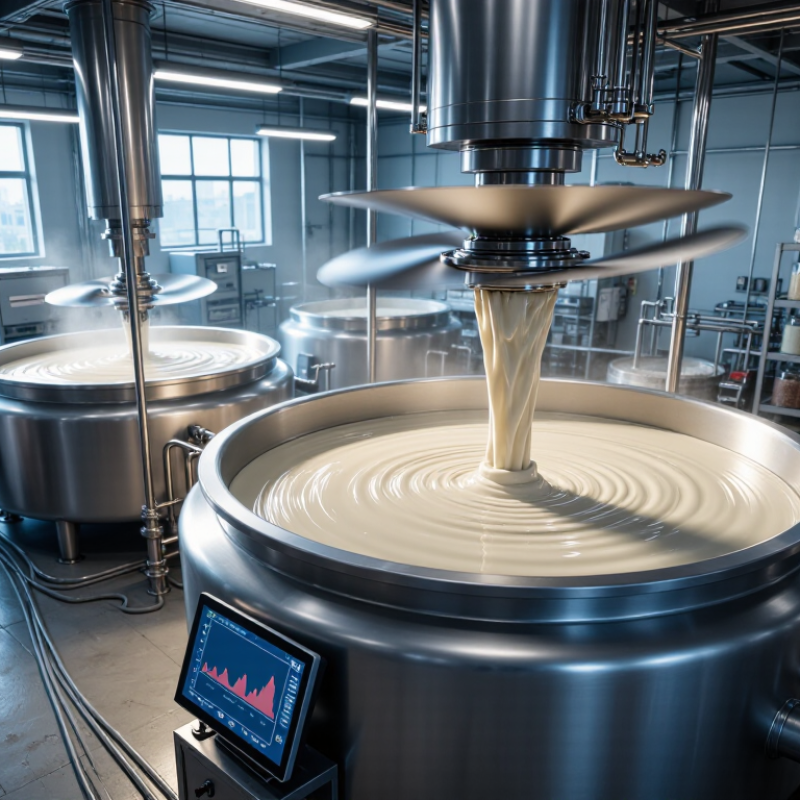
Mixing equipment combines ingredients and moves them through a vessel to create a more consistent mixture. Inside a tank, a motor turns a shaft and impeller. The blades push material outward, upward, or downward, depending on their shape and position. This movement helps reduce pockets of unmixed material. For powders, ribbons or paddles can tumble ingredients together; for liquids, an impeller often circulates fluid around the tank. Some processes also use a scraper to clear material from the vessel wall. The aim is not simply to spin everything quickly. Small changes matter.
During operation, an operator monitors speed, mixing time, temperature, and the appearance of the batch. These factors influence how evenly ingredients disperse and how much heat or air enters the mixture. A thick paste may need a slow, high-torque mixer, while a thin liquid can often circulate with less force. A common misjudgment is assuming that higher speed always means better mixing. It can create excess heat or draw air into the product. More speed is not always better. Check samples from different areas of the vessel, since a smooth surface can hide uneven mixing below. Real batches can behave differently from small trials, so settings may need adjustment.
| Equipment Type | What It Does | How It Works | Commonly Mixed Materials | Typical Strengths | Key Considerations |
|---|---|---|---|---|---|
| Propeller or axial-flow agitator | Circulates liquid through a tank to blend ingredients and promote uniformity. | Rotating blades primarily move liquid parallel to the shaft, creating strong circulation throughout the vessel. | Low-viscosity liquids, solutions, and liquids with suspended solids. | Provides efficient bulk circulation and is well suited to blending and maintaining solids in suspension. | Tank and impeller design affect flow patterns. Baffles are often used to reduce swirling and improve mixing. |
| Turbine or radial-flow agitator | Disperses gas or creates localized shear while mixing tank contents. | Rotating blades direct liquid outward from the shaft, producing radial flow and turbulence around the impeller. | Liquids requiring gas dispersion, liquid blending, or moderate suspension of solids. | Can generate strong local mixing and is useful for gas–liquid contact and dispersion duties. | Higher turbulence can increase power demand and may be unsuitable for shear-sensitive materials. |
| High-shear rotor–stator mixer | Breaks droplets or agglomerates into smaller, more uniformly distributed particles. | A fast rotor draws material through a close-clearance stator, exposing it to intense shear and rapid velocity changes. | Emulsions, dispersions, suspensions, and products containing difficult-to-wet powders. | Can quickly improve dispersion and reduce the size of droplets or soft agglomerates. | May heat the product and does not necessarily reduce hard particles to a smaller primary particle size. |
| Static mixer | Blends flowing materials continuously without a powered rotating mixing element. | Stationary elements inside a pipe repeatedly divide, redirect, and recombine the flowing streams. | Pumpable liquids, compatible liquid streams, and some gas–liquid or viscous flows. | Has no moving parts and can provide continuous mixing within a compact in-line assembly. | Requires flow through the mixer; pressure drop, flow rate, viscosity, and material compatibility must be considered. |
| Ribbon blender | Blends dry powders and granules in a horizontal trough. | Inner and outer helical ribbons move material in opposing directions, creating axial circulation and repeated redistribution. | Free-flowing or moderately cohesive powders, granules, and dry ingredient blends. | Handles sizable powder batches and can distribute minor ingredients through a larger blend. | Very cohesive powders may require a different mixer. Fill level, mixing time, and discharge design affect results. |
| Tumbling blender | Blends free-flowing solids through gentle, repeated movement. | A rotating vessel lifts and cascades material, allowing particles to redistribute through the batch. | Dry, free-flowing powders and granules that do not require intensive shear. | Gentle action can limit particle damage and is suitable for many free-flowing blends. | May mix cohesive materials poorly; excessive mixing can sometimes cause segregation rather than improve uniformity. |
| Planetary mixer | Mixes viscous pastes and doughs throughout a bowl. | The mixing tool rotates on its own axis while orbiting the bowl, covering a broad portion of the batch. | Thick pastes, creams, doughs, and other high-viscosity formulations. | Provides broad batch coverage and can process materials that are too thick for ordinary tank agitators. | Tool choice, bowl shape, batch size, and product viscosity affect mixing time and temperature rise. |
| Kneader | Works dense, highly viscous, or plastic materials through repeated compression and folding. | Intermeshing or counter-rotating blades deform and fold the material, distributing ingredients through the mass. | Dense pastes, rubber-like compounds, doughs, and highly filled materials. | Can apply substantial working action to materials that resist flow under conventional agitation. | Typically requires robust equipment and careful control of fill level, temperature, and cleaning procedures. |